
- Network Security
- Zero-Day
- Vulnerability
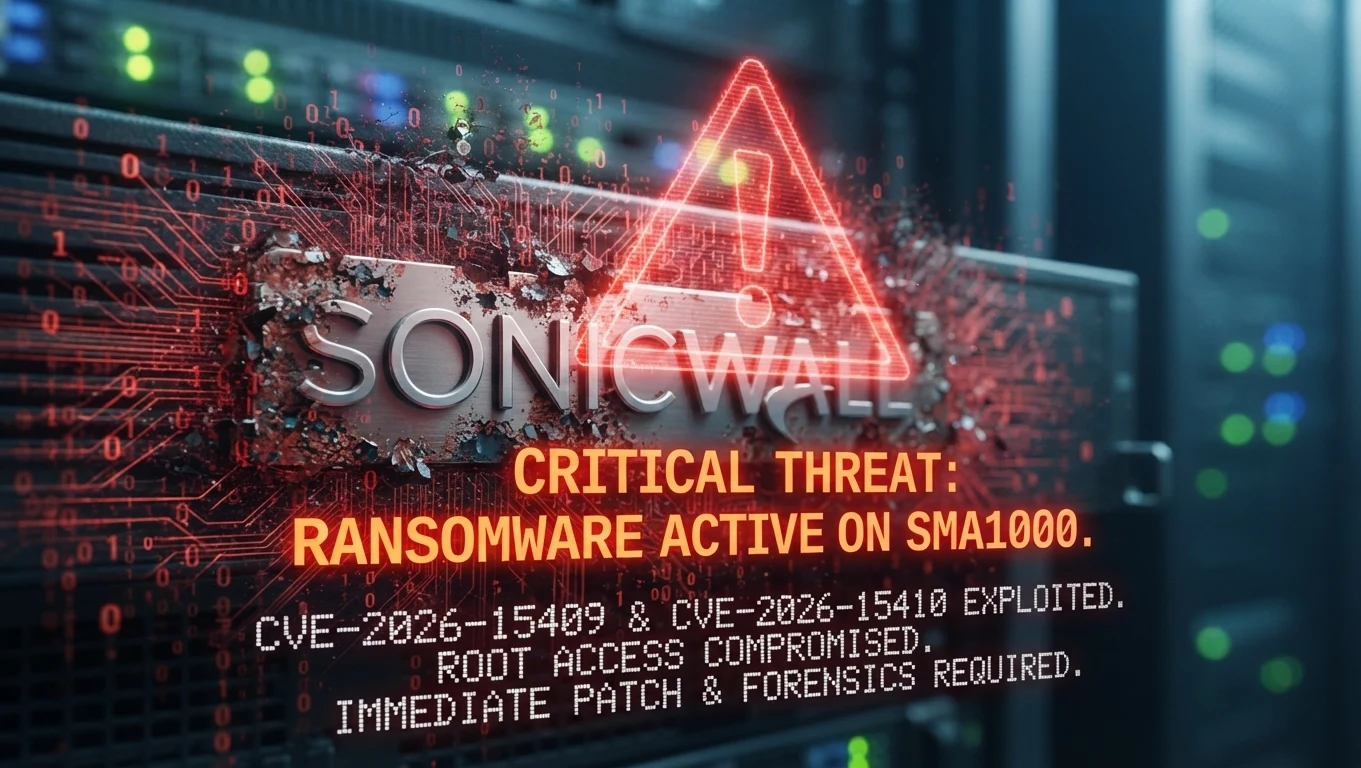
Urgent Security Alert: Active Exploitation of SonicWall SMA1000 Vulnerabilities Threatens Enterprise Infrastructures
By Pivithuru Milan Perera5 min read
Worst impact: From a Single Software Bug to a Full-Scale Corporate Nightmare, What Happens When Hackers Breach the Gate?If this attack is successfully carried out, the impact is equivalent to a criminal bypassing the front gate locks of a secure building, knocking out the security guards, and taking over the entire control room. When hackers exploit these vulnerabilities, they gain total root-level control over the security gateway, meaning they have the highest possible level of authority to rewrite rules, spy on traffic, and alter configurations completely undetected. Beyond just controlling the device, the attackers quietly harvest high-value employee credentials, active login sessions, and multi-factor authentication codes to log into systems later while looking entirely like legitimate staff members. Because the security gateway normally has trusted access to internal systems, the hackers use it as a Trojan horse to bypass internal security walls and wander freely into sensitive parts of the company's network, such as central directory servers, without needing a normal login. Furthermore, they install customized hidden malware inside the gateway appliance so that even if the device is rebooted, secret passages remain open for them to return whenever they want.
The absolute worst-case scenario leads to a catastrophic business crisis driven by ransomware groups like the INC operation. In this final stage, the hackers use their hidden foothold to quietly steal massive amounts of sensitive corporate, financial, or customer data before deploying ransomware to scramble and lock down all critical business files and computer systems. As a result, the company’s operations grind to a complete halt, employees cannot work, customers cannot access services, and critical infrastructure becomes completely unusable. The criminals then demand a massive financial ransom to unlock the systems, while threatening to publicly leak or sell all the private data they stole. Ultimately, this turns a software security bug into a full-scale corporate disaster, resulting in severe financial loss, legal liabilities, and permanent damage to customer trust.
The Exploitation Mechanism: Bridging Public Networks to Root Privileges
Because SMA1000 appliances operate directly at the boundary between public internet connections and sensitive internal networks, breaching them grants attackers immediate leverage within a trusted perimeter gateway. The attack vector chains two major security flaws, beginning with CVE-2026-15409, an unauthenticated server-side request forgery vulnerability with a maximum CVSS score of 10.0 located in the WorkPlace web interface. Attackers exploit the /wsproxy feature to create an unauthorized WebSocket tunnel, connecting the public internet to local services including CouchDB and a privileged control service running on port 8188 that were never meant to be accessed directly from outside. Following this initial foothold, attackers target CVE-2026-15410, a code-injection flaw scored 7.2 in the Appliance Management Console, by abusing a path-traversal vulnerability within the remove_hotfix workflow to execute arbitrary scripts with root privileges. Combined, these vulnerabilities construct an unauthenticated remote code execution pipeline that hands complete command of the hardware over to the attacker.
Threat Tracking and Campaign Progression
Security researchers at Volexity identified the initial wave of attacks, tracking the activity under the designation UTA0533 after discovering compromises dating back to June 22, several weeks prior to SonicWall's public disclosure and hotfix release on July 14. While the early exploitation waves utilized general hosting infrastructure with varying degrees of success, subsequent post-disclosure activities have been heavily driven by the INC ransomware-as-a-service group, resulting in accelerated data exfiltration and extortion attempts.
Stealthy Toolkits and Persistent Backdoors Implants
Forensic investigations uncovered a specialized malware suite tailored specifically for execution inside SonicWall SMA architectures. This toolkit features ROOTRUN (xzfind), a set-user-ID binary granting unprivileged mechanisms the ability to launch commands with root permissions, alongside KNUCKLEBALL (deploy_new.py), a Python persistence loader integrated into the WorkPlace startup routine. KNUCKLEBALL embeds Java archives containing Suo5 for HTTP proxy forwarding and ORANGETAIL, a customized Java web shell. Furthermore, attackers manipulated NGINX configurations to reroute specific paths like /__api__/login and /__api__/logout straight to hidden backend components while returning standard error pages to ordinary visitors.
Lateral Movement and Credential Harvesting Tactics
Beyond merely taking control of the gateway appliance itself, threat actors are leveraging the compromise to deepen their foothold across the broader enterprise. Investigators observed attackers extracting active session databases, high-value user credentials, and time-based one-time password configurations. Additional findings indicate the use of tools like tcpdump to intercept unencrypted LDAP traffic flowing between the gateway and internal directory systems, alongside direct authentication attempts originating from the SMA appliance's internal address toward domain controllers to bypass standard network segmentations.
Scope of Impact and Essential Mitigation Guidelines
The vulnerabilities impact specific firmware builds across SMA1000 models 6210, 7210, and 8200v, as well as the Central Management Server, while leaving SMA 100 products and firewall SSL VPN features unaffected. SonicWall has introduced fixes in versions 12.4.3-03453 and 12.5.0-02835, which organizations must apply immediately. However, because systems could have been compromised weeks prior to patching, simple firmware updates are insufficient to remove legacy backdoors or stolen secrets. Security teams must perform deep forensic reviews, such as inspecting extraweb_access.log and ctrl-service.log—treat any confirmed intrusion as a total system compromise by re-imaging or redeploying units from scratch, and aggressively rotate all administrative credentials, service tokens, and authentication secrets.
**Go through given links for more details:**
Keep reading
More articles
Explore other writeups on network security, firewalls, and practical engineering.
what is wireshark and why it is used ? (Part 1)
Wireshark is a network protocol analyzer that allows us to capture and inspect network packets as they travel between devices. Instead of simply looking at whether a connection works or fails, Wireshark allows us to look inside the communication and understand what is happening at the packet level.

Reflecting on My BSc (Hons) in Information Technology Specializing in Computer Systems & Network Engineering at SLIIT (2021–2025)
When I look back at my journey starting from July 2021 all the way to completing my final requirements, enrolling in the BSc (Hons) in Information Technology specializing in Computer Systems and Network Engineering (CSNE) at the Sri Lanka Institute of Information Technology (SLIIT) was one of the most defining choices of my professional life.
The Hidden Vulnerabilities of Public Wi-Fi: Why Open Networks Are a Trap
Ever logged onto a coffee shop's "free" Wi-Fi and did your office work while enjoying a good cup of coffee freely and happily, did you feel completely safe on free Wi-Fi? Think again. Behind that open connection lies a silent playground for hackers where passwords don't even need to be cracked, because your active sessions are stolen in plain sight. Discover why multi-factor authentication isn't enough and what you can do right now to protect your data before your next public login. Read the full post to uncover the hidden traps of unsecured networks!
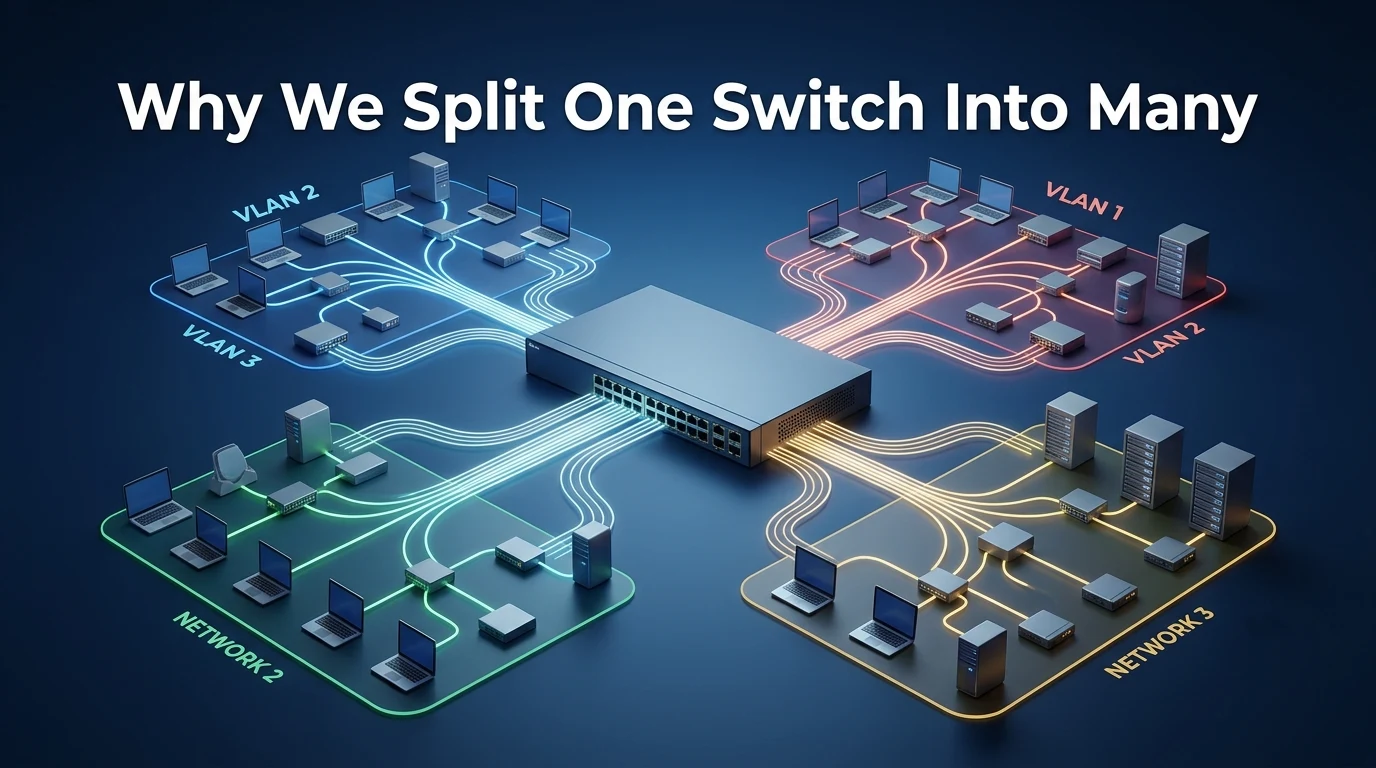
VLAN Basics: Why We Split One Switch Into Many
Tags, ports, PVIDs, and trunks explained from the ground up, starting with the problem VLANs actually solve